What is GEO?
Generative Engine Optimization - getting your brand named as a source when someone asks ChatGPT, Perplexity or Gemini. What it is, and what actually influences it.
GEO, or Generative Engine Optimization, is the practice of building the signals that lead an AI assistant to name your business as a source in its answer. It applies to tools like ChatGPT, Perplexity, Gemini and Copilot, where the model writes a reply and cites a shortlist of sources rather than returning a ranked list of links.
Why GEO exists as a separate discipline
GEO exists because a growing share of questions never reach a search results page at all. The user asks an assistant, reads a written answer, and either acts on it or does not. There is no list to rank in, so the traditional target disappears.
The scale is what makes this worth attention rather than a curiosity. OpenAI announced on 27 February 2026 that ChatGPT had reached 900 million weekly active users, up from 800 million in October 2025. Whatever share of those conversations touch commercial questions, it is not a rounding error.
How an AI assistant decides who to cite
An assistant does not rank sources the way a search engine ranks pages. It assembles an answer and attaches a small number of citations, drawing on your own pages, mentions of you on sites it treats as reliable, structured facts such as schema and business listings, and whether those sources agree with each other. Corroboration carries unusual weight: a claim made only by you is weaker evidence than the same claim made by you and confirmed elsewhere.
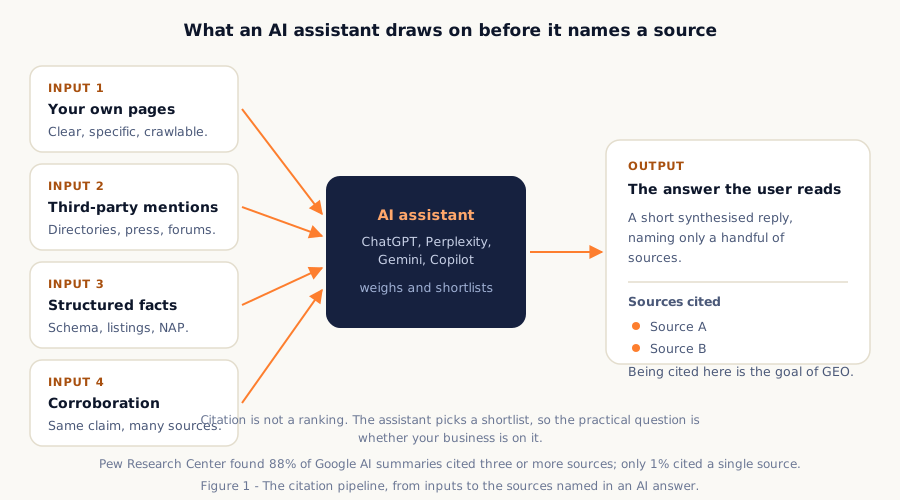
Why a citation shortlist is more winnable than a first position
In a ranked list there is one first position. In an AI answer there is usually a small group of cited sources, which changes the arithmetic in your favour.
Pew Research Center, analysing 68,879 Google searches in March 2025, found that 88% of AI summaries cited three or more sources and only 1% cited a single source. Being one of several named sources is a materially easier target than displacing whoever currently holds the top ranking.
The same study carries a caution worth stating plainly: users clicked a link inside an AI summary in only 1% of visits. A citation is therefore better understood as brand exposure and credibility at the moment of decision, rather than as a reliable traffic channel.
| What Pew measured (Google AI summaries, March 2025) | Figure |
|---|---|
| Summaries citing three or more sources | 88% |
| Summaries citing only one source | 1% |
| Visits where a user clicked a link inside the summary | 1% |
| Median length of an AI summary | 67 words |
| Share of sources that were Wikipedia, YouTube or Reddit | 15% |
Source: Pew Research Center, published 22 July 2025. Analysis of 68,879 Google searches by 900 US adults, March 2025.
How to improve your chances of being cited
- Write pages that are easy to quote accurately. State facts plainly and completely in single sentences. A model that has to infer your service, location or price is more likely to get it wrong or skip you.
- Make your entity unambiguous. Use the same business name, address, phone number and description everywhere. Inconsistency across sources reads as uncertainty about who you are.
- Add structured data. Organization, Article and FAQPage schema tell machines what the page is and who published it, rather than leaving them to guess from layout.
- Earn third-party corroboration. Get the same facts stated on sources you do not own - directories, industry listings, press, genuine community discussion. Self-assertion alone is weak evidence.
- Audit the answers monthly. Ask the assistants your customers' questions, log which brands and sources appear, and treat gaps as content tasks.
What GEO is not
- It is not a replacement for SEO. Assistants draw heavily on pages that already rank and on sources that are already established. Strong organic performance remains a prerequisite.
- It is not keyword stuffing for robots. Repetitive, keyword-dense text reads as low quality to the models doing the citing.
- It is not a guarantee. Outputs vary between assistants, between users and between sessions. Treat measurement as a trend over time, not a fixed position.
Where GEO fits alongside SEO and AEO
SEO makes your pages eligible to be found. AEO makes a passage within them displayable as an answer inside a search engine. GEO makes the brand behind them citable by assistants operating outside search entirely. Read the full comparison, or what AEO is.
Sources
- Chapekis, A. and Lieb, A., "Google users are less likely to click on links when an AI summary appears in the results", Pew Research Center, 22 July 2025.
- OpenAI weekly active user figure announced 27 February 2026, as reported by Search Engine Land.
The next layer
AEO vs GEO vs SEO
How the three layers differ, side by side, and which order to work on them in.
Read the guide →What is AEO?
How search engines pick the passage they display, and how to write one they can lift.
Read the guide →GEO Training
Hands-on GEO work applied to your own brand, inside the 2-day course.
View the module →GEO questions
What does GEO stand for?
GEO stands for Generative Engine Optimization. It is the practice of building the content, structure and third-party signals that lead a generative AI assistant - ChatGPT, Perplexity, Gemini or Copilot - to name your business as a source when it answers a user's question.
How is GEO different from SEO and AEO?
SEO competes for a position in a ranked list. AEO competes for the answer box displayed above that list inside a search engine. GEO competes for a place on the shortlist of sources an AI assistant names, in a product that may show no ranked list at all. SEO and AEO optimise pages; GEO optimises how your brand is understood as an entity across the whole web.
Can I control what AI tools say about my business?
No, and any provider claiming otherwise is overselling. You cannot edit a model's output. What you can influence is the material it draws on: the clarity and accuracy of your own pages, the consistency of your business details across directories and listings, and whether independent third-party sources state the same facts. Influence, not control.
How many sources does an AI answer usually cite?
More than one, which is the encouraging part. Pew Research Center found that 88% of Google AI summaries cited three or more sources, and only 1% cited a single source. Unlike the single first position in a ranked list, a citation shortlist has several places on it.
How do I measure whether GEO is working?
Run your customers' real questions through ChatGPT, Perplexity and Google AI Mode on a fixed schedule - monthly works - and record three things: whether your brand is named, whether the description of it is accurate, and which competitors appear alongside you. Consistency of method matters more than the tool you use.