Difference Between AEO, GEO & SEO
Three acronyms, one goal: getting found. Here is what each one actually means, how they differ, and why all three now decide whether a customer ever reaches you.
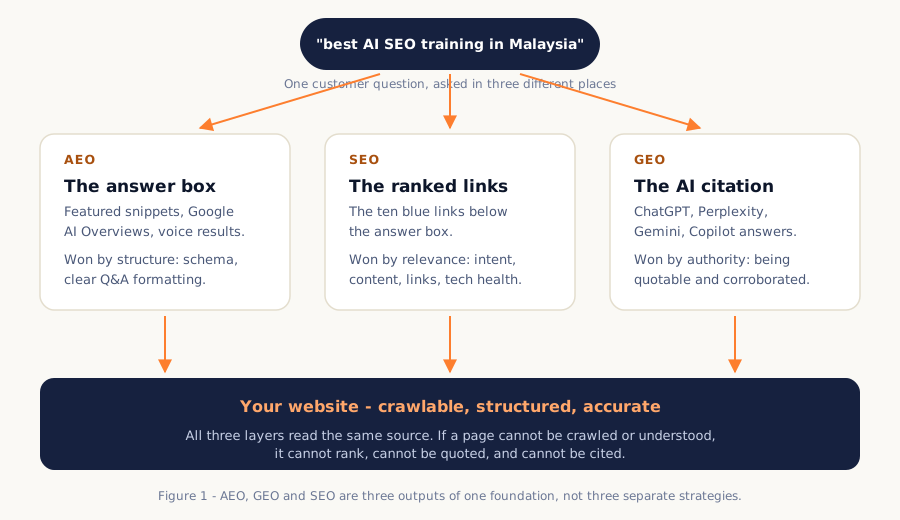
SEO gets your page ranked in Google's list of links. AEO gets your content lifted into the answer box or AI Overview above those links. GEO gets your brand named as a source inside AI assistants like ChatGPT and Perplexity. Same website, three different positions - and three different sets of tactics.
What changed, and why the three names exist
For twenty years, search visibility meant one thing: rank in a list of links and earn the click. That model is no longer the only one. Search engines now answer many questions on the results page itself, and a growing number of people skip the search engine entirely and ask an AI assistant.
The evidence for the first shift is measurable. In a study of 68,879 Google searches made by 900 US adults in March 2025, Pew Research Center found that when an AI summary appeared, users clicked a traditional search result in 8% of visits. When no AI summary appeared, they clicked in 15% of visits - close to double. Clicks on the links inside the AI summary itself were rarer still, at 1% of visits.
The scale of the second shift is set by usage. OpenAI announced on 27 February 2026 that ChatGPT had reached 900 million weekly active users, up from 800 million in October 2025.
What is SEO?
Search Engine Optimization is the practice of making a page eligible to rank in a search engine's list of results. It covers search intent and keyword research, on-page structure, internal linking, technical health such as crawlability and speed, and the external links that signal authority. Its output is a position in the ranked list.
SEO remains the prerequisite layer. Search engines assemble answer boxes and AI summaries from pages they have already retrieved, so a page that cannot rank is not a candidate for either.
What is AEO?
Answer Engine Optimization is the practice of formatting content so a search engine can lift a passage from it and display that passage as the answer - in a featured snippet, a Google AI Overview, or a spoken voice result. Its output is a position above the ranked links, usually with a source link attached.
Pew's data shows how strongly this depends on how the question is asked: 60% of Google searches beginning with a question word such as who, what, when or why produced an AI summary in March 2025, against just 8% of one- or two-word searches. The more a query looks like a question, the more likely an answer is generated rather than a list returned.
What is GEO?
Generative Engine Optimization is the practice of building the signals that lead an AI assistant to name your business as a source. Its output is a citation inside a synthesised answer - not a ranking position, because there is no ranked list to sit in.
The opportunity here is that AI answers do not cite a single winner. Pew found that 88% of AI summaries cited three or more sources, and only 1% cited just one. A shortlist with several places on it is a more winnable target than a single first position.
AEO vs GEO vs SEO compared
The three differ in what they optimise for, where the result appears, and how you know it worked.
| SEO | AEO | GEO | |
|---|---|---|---|
| Full name | Search Engine Optimization | Answer Engine Optimization | Generative Engine Optimization |
| Goal | Rank in the results list | Be the answer displayed | Be cited as a source |
| Appears in | Google and Bing blue links | Featured snippets, Google AI Overviews, voice results | ChatGPT, Perplexity, Gemini, Copilot answers |
| Core tactics | Search intent, on-page, technical health, links | Schema markup, concise self-contained answers, Q&A structure | Citable content, entity consistency, third-party corroboration |
| Unit of competition | The page | The passage | The brand as an entity |
| Measured by | Rankings and organic traffic | Snippet and Overview appearances | Brand mentions in AI answers |
| Winners per query | Ten links on page one | Usually one answer | A shortlist - 88% of AI summaries cite three or more sources |
Winners-per-query figure for AI summaries: Pew Research Center, July 2025 (see sources below). Other rows describe standard practice.
How to work on all three
Order matters, because each layer depends on the one before it. This is the sequence we teach:
- Fix the foundation first. Confirm your pages are crawlable, load quickly and have a clear structure. Nothing else works until search engines can retrieve and parse the page.
- Add a liftable answer to each page. Under each main heading, write a self-contained 40 to 60 word paragraph that fully answers the heading question before you expand on it.
- Mark the page up with schema. Add JSON-LD structured data - Article, FAQPage, Organization, BreadcrumbList - so machines can identify what the page is and who published it.
- Build corroboration off-site. Get the same facts about your business stated consistently on directories, listings and third-party pages, so an AI assistant sees agreement rather than a single claim.
- Measure by asking the engines. Track answer-box appearances in Google Search Console and check AI assistant answers manually each month to see whether your brand is being named.
Common mistakes
Three errors account for most wasted effort in this area.
- Treating GEO as a replacement for SEO. Assistants and AI Overviews draw on pages that already rank. Abandoning SEO removes you from the candidate pool entirely.
- Writing long build-ups before the answer. If the answer to a heading only arrives three paragraphs later, there is no self-contained passage to lift.
- Adding Open Graph tags and calling it structured data. Open Graph controls how a link previews on social media. It is not schema, and it does not make a page eligible for rich results.
Sources
- Chapekis, A. and Lieb, A., "Google users are less likely to click on links when an AI summary appears in the results", Pew Research Center, 22 July 2025. Analysis of 68,879 Google searches from 900 US adults, March 2025.
- OpenAI weekly active user figure announced 27 February 2026, as reported by Search Engine Land.
The next layer
What is AEO?
How search engines choose the passage they display, and how to write one they can lift.
Read the guide →What is GEO?
What an AI assistant weighs before naming a source, and how to become one of them.
Read the guide →AI SEO Training
All three layers over 2-day, on-site, applied to your own website.
View the course →Common questions
What is the difference between AEO, GEO and SEO?
SEO (Search Engine Optimization) helps a page rank in Google's list of blue links. AEO (Answer Engine Optimization) helps your content become the direct answer shown above those links, in featured snippets and Google AI Overviews. GEO (Generative Engine Optimization) helps your brand get cited inside generative AI answers from ChatGPT, Perplexity, Gemini and Copilot. They target three different positions produced by the same underlying content.
Do I need all three, or can I pick one?
You need all three, because they share one foundation. A page that cannot be crawled or understood will not rank, will not be quoted in an answer box, and will not be cited by an AI assistant. SEO makes your pages eligible, AEO makes them liftable, and GEO makes them citable. Doing only SEO leaves the answer box and the AI citation to a competitor.
Which one should I do first?
SEO fundamentals come first. Search engines only consider pages they have already retrieved as candidates, so crawlability, site structure and topical relevance are prerequisites. Once a page can be found, AEO formatting and GEO authority signals determine whether it gets quoted or cited.
Is GEO just a new name for AEO?
No. AEO targets answer features inside a search engine - featured snippets, Google AI Overviews and voice results - where a passage is lifted from a ranking page. GEO targets standalone AI assistants that a user queries directly, where the model synthesises an answer and names a shortlist of sources. The tactics overlap on structure but differ on authority and corroboration.
How do I know if AI tools are already mentioning my business?
Ask them. Open ChatGPT, Perplexity and Google AI Mode and run the questions a customer would ask - "best [your service] in [your city]", "who should I use for [your service]" - then record which businesses get named and which sources are cited. Repeat monthly. This manual check is the practical starting point before any paid monitoring tool.