What is AEO?
Answer Engine Optimization - being the answer rather than one of ten links. What it is, how engines choose, and how to write a passage they can lift.
AEO, or Answer Engine Optimization, is the practice of structuring content so a search engine can lift a passage from your page and display it as the direct answer to a question - in a featured snippet, a Google AI Overview, or a spoken voice result. It competes for the position above the ranked links, not within them.
Why AEO matters now
Answer placements changed what a ranking is worth. When a search engine displays the answer on the results page, the user's question is resolved before any link is clicked, and the click that used to follow a good ranking often does not happen.
Pew Research Center measured the effect across 68,879 Google searches by 900 US adults in March 2025. Where an AI summary appeared, users clicked a traditional result in 8% of visits. Where none appeared, they clicked in 15%. They were also more likely to stop browsing altogether after a page with a summary - 26% of such visits ended the session, against 16% without one.
The practical conclusion is not that answer placements should be avoided. They cannot be. It is that if an answer is going to be shown regardless, it should be drawn from your page, carrying your name as the source.
How a search engine picks the answer it shows
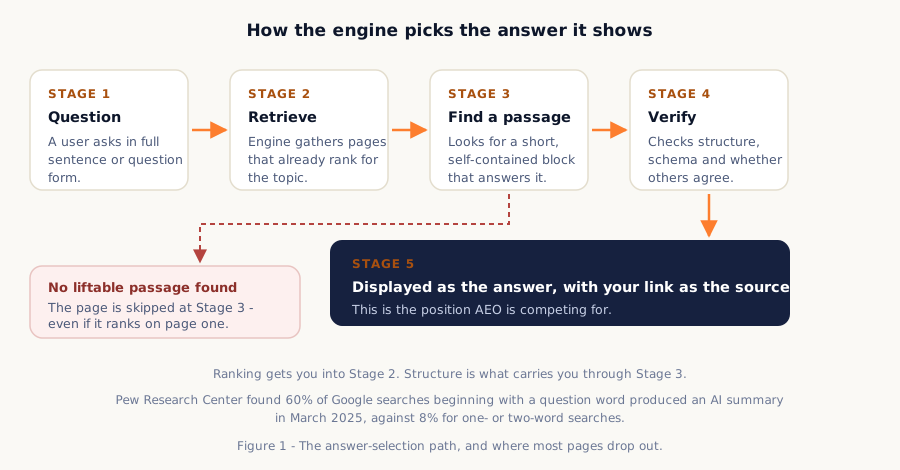
The selection runs in stages, and most pages fail at the same one. The engine retrieves pages that already rank for the topic, then looks within those pages for a passage that answers the question on its own. A page can rank on the first page of results and still be skipped, simply because no single block of its text answers the question without surrounding context.
What kinds of questions trigger an answer
Not every search produces one. The shape of the query is the strongest predictor, and Pew's data quantifies it.
| Type of Google search | Produced an AI summary |
|---|---|
| One or two words | 8% |
| Ten words or more | 53% |
| Begins with who, what, when or why | 60% |
| Contains both a noun and a verb | 36% |
| All searches in the study | 18% |
Source: Pew Research Center analysis of 68,879 Google searches, March 2025, published 22 July 2025. US data.
The pattern is consistent: the more a query resembles a spoken question, the more likely an answer is generated instead of a list. That is why AEO work starts with question-phrased headings rather than keyword-phrased ones.
What a liftable answer looks like
A passage an engine can display has four properties. It sits directly under a heading phrased as the question. It is short - Pew found the median AI summary ran to 67 words. It is self-contained, resolving the question without depending on the paragraph before it. And it states the answer first, rather than arriving at it after a preamble.
The block at the top of this page is written to that specification, and so is the one on every page in this section.
How to optimise a page for answer engines
- Phrase the heading as the question. Use the exact wording a customer would type or say. Engines pattern-match headings against queries, so "How much does AI SEO training cost?" outperforms "Pricing".
- Answer in the first 40 to 60 words. Put a complete, self-contained answer immediately under the heading. Do not build up to it - a passage that depends on earlier paragraphs cannot be lifted.
- Use unambiguous structure. Tables for specifications, ordered lists for processes, plain paragraphs for definitions. Avoid burying an answer inside a decorative callout that machines may not parse.
- Add the matching schema. Mark up FAQ sections with FAQPage and process sections with HowTo. The markup must match the visible text on the page exactly.
- Check what is displayed today. Search your target questions and record which source is being shown. That tells you what format the engine currently prefers for that query.
Where AEO fits alongside SEO and GEO
AEO sits in the middle of three layers. SEO makes a page eligible by getting it retrieved and ranked. AEO makes a passage within that page displayable. GEO makes the brand behind the page citable by AI assistants that operate outside the search results page entirely.
See the full comparison of AEO, GEO and SEO, or read what GEO is.
Sources
- Chapekis, A. and Lieb, A., "Google users are less likely to click on links when an AI summary appears in the results", Pew Research Center, 22 July 2025. All AI summary percentages and the 67-word median on this page are from this study.
The next layer
AEO vs GEO vs SEO
How the three layers differ, side by side, and which order to work on them in.
Read the guide →What is GEO?
Getting cited inside ChatGPT, Perplexity and Gemini answers - a different game to snippets.
Read the guide →AEO Training
Hands-on AEO work applied to your own pages, inside the 2-day course.
View the module →AEO questions
What does AEO stand for?
AEO stands for Answer Engine Optimization. It is the practice of structuring content so a search engine can extract a passage from your page and display it directly as the answer to a user's question, in a featured snippet, a Google AI Overview or a spoken voice result.
How is AEO different from SEO?
SEO competes for a position in the list of links. AEO competes for the answer displayed above that list. SEO works at the level of the page, AEO works at the level of the passage - a specific block of text short and self-contained enough to be lifted out and shown on its own.
What kind of content wins answer placements?
Content that answers a question immediately and completely in one short block, typically 40 to 60 words, positioned directly under a heading phrased as the question itself. Definitions, direct comparisons, step lists and specification tables are lifted most often because their structure is unambiguous.
Does AEO reduce traffic to my website?
It can, and the data shows why. Pew Research Center found users clicked a search result in 8% of visits when an AI summary was present, versus 15% when it was not. AEO is a response to that shift rather than a cause of it: if an answer is going to be displayed either way, it is better that it comes from your page with your link attached.
How do I know if a page has won an answer placement?
Google Search Console does not label answer placements separately, so check manually. Search the target question in an incognito window and look at whether a snippet or AI Overview appears and which source it names. Log the results monthly for your priority questions.